Grace
Paradise LostGrace is the unmerited divine favor by which God refuses to let fallen humanity remain wholly lost. In Paradise Lost, it begins as God’s freely offered response to human disobedience, restores capacities damaged by sin, and reaches its fullest expression when the Son of God offers his own life for mankind. Grace therefore joins mercy to justice: it does not simply cancel the consequences of the Fall, but provides the means by which justice is satisfied and humanity may be reconciled to God.
Divine Initiative and Human Response
Grace originates entirely in God rather than in fallen human will. God declares that humanity will be saved “who will,” yet not through autonomous power, but through grace freely bestowed by him. Because sin has forfeited and enthralled human powers, God promises to renew them and to uphold humanity once more against its mortal foe. The purpose of this support is both compassionate and corrective: restored people are to recognize the frailty of their fallen condition and attribute deliverance to God alone.
This initiative does not abolish moral responsibility. God will clarify darkened understanding and soften stony hearts so that people may pray, repent, and offer due obedience. Even sincere effort is insufficient as an independent claim upon salvation, but it is still required as the form in which grace is received and sustained. The guiding power placed within human beings is Conscience, described as an internal umpire whose direction, if heeded, leads to “light after light” and eventual safety. Grace thus works through an enabled conscience rather than replacing judgment, deliberation, or perseverance.
The offer also has a limit in human refusal. Those who neglect and scorn God’s long suffering and day of grace will not taste it; their hardness and blindness deepen until they stumble farther into ruin. Yet the exclusion is presented as applying to those who deliberately reject mercy, not to humanity indiscriminately. The structure is therefore double: grace precedes repentance, making repentance possible, while contempt for grace confirms the fallen state it was offered to heal.
Grace, Justice, and the Problem of Debt
The need for grace arises from a legal and theological crisis. Humanity’s disobedience is treated as treason against Heaven’s supremacy, and the penalty is death. If humanity dies without another payment, justice remains unsatisfied; if justice is abandoned, the divine order is compromised. The Father therefore asks where an able and willing being can offer “death for death,” but the heavenly choir remains silent. No angel appears as patron, intercessor, or substitute capable of assuming mankind’s deadly forfeiture.
Grace enters this economy not as a cheap remission but as a costly mediation. The Son of God renews the offer of mercy and presents himself as the necessary means through which it can reach the helpless. Fallen humanity has no adequate offering of its own: dead in sins, it cannot even seek the aid required for its rescue. The Son of God therefore volunteers to become accountable as man, to leave the Father’s bosom and glory, and to bear the anger that humanity cannot bear for itself.
This exchange preserves both mercy and justice. God’s judgment is not revoked, and the sentence of death is not treated as meaningless; instead, the Son of God assumes the penalty. His obedience and love fulfill the law that humanity failed to fulfill, while his death pays the punishment due to Adam and to those whose sin grows from Adam’s transgression. Grace is consequently portrayed as an economy of substitution: the innocent accepts the cost so that the guilty may receive life, but the value of the payment is not human merit. It is the Son of God’s own person and willing sacrifice.
The Son of God as Mediator and Sacrifice
The Son of God embodies grace before the human story reaches its later fulfillment. His compassion is visibly expressed in his face, and his speech to the Father begins from the divine decision that man should find grace. When the Father’s decree makes clear that no creature can redeem mankind, the Son of God offers life for life. He willingly accepts mortality, reproach, and death, while trusting that the Father will not abandon his unspotted soul to corruption.
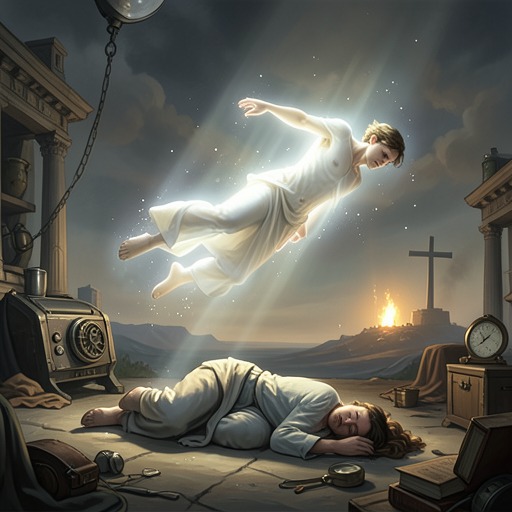
The promised sacrifice contains its own reversal. The Son of God yields to Death, but Death cannot retain him: he rises, defeats his vanquisher, and deprives the powers of darkness of their supposed spoil. His triumph does not merely rescue isolated individuals; it leads Hell captive, breaks the power of Satan, and ultimately permits the redeemed to return to Heaven. Grace therefore moves through apparent defeat toward victory. The cross is at once the place where punishment is endured and the instrument by which Sin and Death lose their authority.
The Father identifies this mediation with the restoration of human nature itself. The Son of God is to join mankind’s nature to his own, become man among men through wondrous birth from virgin seed, and occupy Adam’s place as the head of humanity. Adam’s failure spreads guilt through his descendants, while the Son of God’s merit is imputed to those who renounce their own deeds, whether righteous or unrighteous, and live in him. Grace thus establishes a second root for the human race: as many perish in Adam, so many as are restored receive new life through the Son of God, and without him none are restored.
Prayer, Repentance, and Reconciliation
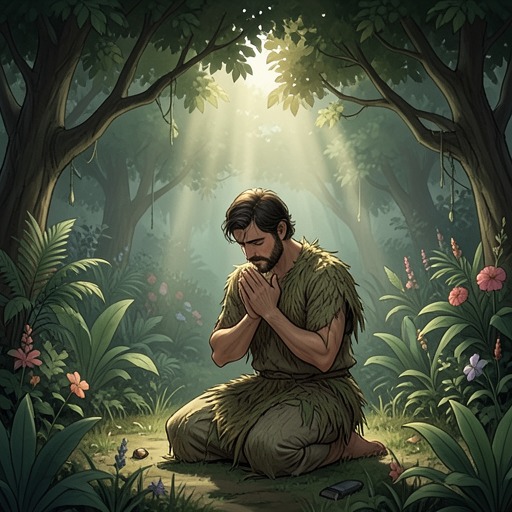
After the Fall, grace becomes perceptible in the changed condition of Adam and Eve. They stand repentant and pray because prevenient grace has removed the stone from their hearts and caused regenerated flesh to grow in its place. Their sighs are not merely expressions of grief; they are inspired by the Spirit of prayer and ascend more swiftly than formal oratory. The scene gives grace a bodily and vocal form: hardened hearts become responsive, and inarticulate sorrow becomes an acceptable petition before God.
The Son of God receives and presents these prayers as an intercessor. He calls them the first fruits of grace implanted in man and brings them before the Father in a golden censer mixed with incense. Their contrition is more pleasing than anything Adam could have produced while still innocent, because the prayers arise from a heart that has recognized its fault. The Son of God offers to interpret their unskilled prayer, to take their good and bad works upon himself, and to perfect what they cannot perfect. His advocacy turns repentance into reconciliation without pretending that the Fall never occurred.
The Father accepts the Son of God’s request, but the acceptance does not permit Adam and Eve to remain in Paradise. Grace mitigates their doom rather than reversing every consequence. Their expulsion is required because their corruption has made continued residence among the pure immortal elements impossible; mortality becomes the remedy for a condition in which immortality would only perpetuate misery. Death, followed by a life tested through tribulation and refined by faith and faithful works, is transformed into a passage toward a second life in the renewal of the just.
Adam recognizes the efficacy of prayer when he recalls kneeling before the offended Deity. He believes he saw God become placable and mild, and peace returned to his breast as he remembered the promise that Eve’s seed would bruise the enemy. Eve, who brought death upon all, is nevertheless addressed as the mother of all mankind and the source of life. Her altered status dramatizes grace’s capacity to bring life out of the very person through whom death entered the world. Her self-accusation remains, but condemnation is no longer the final meaning of her identity.
Faith, Redemption, and the Larger Design
The prophetic account given by Michael clarifies how grace reaches beyond the immediate scene of repentance. The coming Saviour will fulfill the law through obedience and love, endure a reproachful life and cursed death, and rise before the third dawning light. His obedience will be imputed to those who believe in his redemption, not because their legal works are sufficient, but because faith receives his merit. That faith is not empty: the promised salvation belongs to those whose faith is not void of works and who embrace the benefit offered through the redeemer.
Grace also widens the scope of redemption. Salvation will not remain confined to the descendants of Abraham’s body, but will be preached to the descendants of Abraham’s faith throughout the world. The Son of God’s resurrection will be followed by appearances to his disciples, who are charged to teach all nations and baptize believers as a sign of washing from guilt into pure life. The movement from one human pair to all nations shows grace expanding from a particular promise into a universal offer, while still depending on faith and faithful response.
The final shape of grace is eschatological. The Son of God will ascend in triumph, take his seat at God’s right hand, and return when the dissolution of the world is ripe to judge the living and the dead. The unfaithful will face judgment, while the faithful will be received into bliss in Heaven or on a renewed Earth. The Earth will become Paradise, happier than Eden, so that grace does not merely restore the original condition but carries creation toward a greater happiness than what was lost. The poem’s governing paradox is that evil becomes the occasion for a more astonishing good: through Fall, punishment, repentance, sacrifice, and resurrection, grace causes divine justice and mercy to converge in the restoration of creation.